
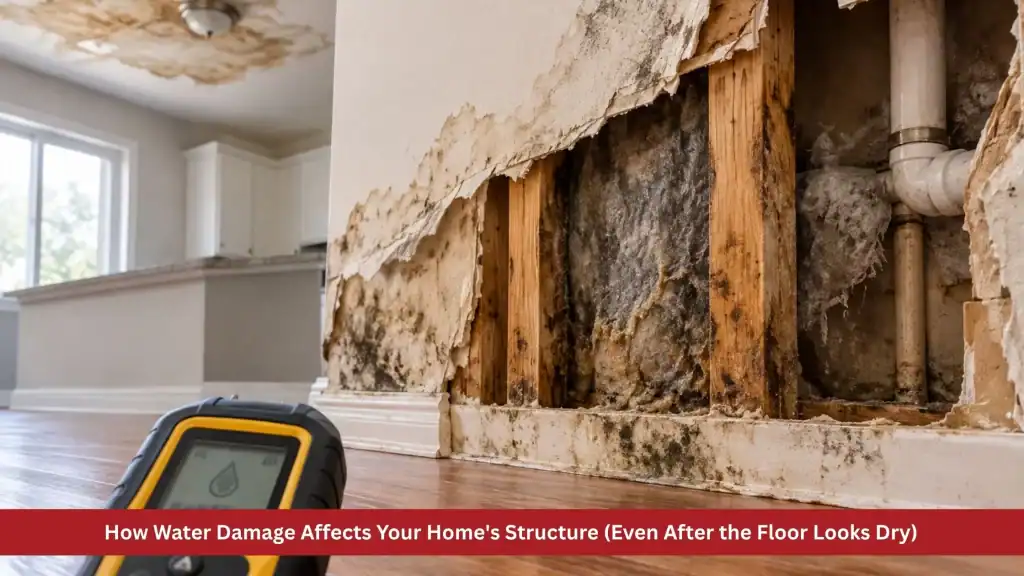
| Water damage affects your home’s structure long after the surface dries because moisture migrates into framing, subfloor, insulation, and wall cavities where it cannot evaporate naturally. In Las Vegas homes, where tight construction and limited airflow are common, hidden moisture creates mold within 24 to 48 hours and begins degrading wood framing within days. Professional water damage restoration services use moisture meters and thermal imaging to find water the eye cannot see, then extract and dry the structure completely before repairs begin. |
The floor feels dry. The standing water is gone. The towels are picked up and everything looks fine. Most Las Vegas homeowners stop there, and that is exactly where the real problem begins.
Water does not stop moving just because the visible surface dried out. It wicks upward into drywall, migrates laterally through subfloor panels, absorbs into wall framing, and pools in cavities where no airflow reaches. By the time the surface looks fine, moisture has often been sitting inside the wall assembly for hours or days, quietly doing the kind of damage that does not show up until it becomes expensive.
Understanding what home water damage repair actually involves, and why the window to act is shorter than most homeowners realize, is the difference between a contained remediation and a full structural rebuild.
Why Does Water Damage Continue After the Floor Dries?
Surface drying and structural drying are two completely different things. When water from a burst pipe, appliance leak, or monsoon intrusion hits your floor, what you see is only the beginning of where it goes.
Water follows the path of least resistance. It moves down through flooring into the subfloor. It seeps under baseboards and into wall cavities through the gap at the bottom plate. It travels along framing members and pooling occurs at the lowest accessible point in the wall or floor assembly. On upper floors, it penetrates through the subfloor into the ceiling of the room below.
In Las Vegas, homes are often tightly constructed with stucco exteriors, minimal crawl space, and slab-on-grade foundations. That construction style is good for energy efficiency and climate control. It is not good for water migration. There is nowhere for trapped moisture to go naturally, and the dry desert air that evaporates surface water quickly does nothing for moisture that is already sealed inside a wall cavity or beneath a glued-down floor.
A floor that feels dry underfoot can have subfloor panels sitting at 20 to 30 percent moisture content, well above the 8 to 12 percent range where structural wood is stable. The damage is invisible until it becomes visible, and by then it has been building for days.

How Does Water Damage Affect Subfloor and Floor Framing in Las Vegas Homes?
The subfloor is the structural layer between your finished flooring and the floor joists. In most Las Vegas homes, it is oriented strand board (OSB) or plywood, both of which absorb moisture readily.
When OSB gets wet and stays wet, it begins to swell at the edges and delaminate through the layers. The swelling creates ridges and soft spots in the finished floor above. Once delamination starts, the structural integrity of the panel is compromised and the material cannot be dried back to a usable state. It needs to come out.
Floor joists beneath the subfloor are typically dimensional lumber, and lumber in sustained contact with moisture begins to deteriorate. The process is not instant, but it is progressive. Joists that develop soft spots or rot cannot be sistered back to full strength without significant structural work. In severe cases, a section of floor framing needs to be replaced entirely.
For Las Vegas homeowners dealing with water damage from a washing machine leak, refrigerator line failure, or under-sink plumbing drip, the subfloor is almost always involved if the event went undetected for more than a few hours. Professional water damage restoration services include subfloor moisture assessment as a standard part of the evaluation.
What Does Water Damage Do to Drywall and Wall Framing?
Drywall absorbs water immediately. The gypsum core wicks moisture from the bottom up, and the paper facing on the interior provides an ideal surface for mold growth once conditions are right. Drywall that gets wet is almost always a replacement rather than a drying situation. Dried drywall that was once wet loses structural integrity and develops a chalky, soft texture that does not hold fasteners or finish properly.
Behind the drywall, the picture gets more serious. Wall framing is typically 2×4 or 2×6 studs, and wet wood framing in an enclosed wall cavity sits in exactly the conditions mold needs: darkness, organic material, and moisture. The Las Vegas desert climate does not help here. Outdoor humidity is low, but inside a wall cavity that has absorbed water from a plumbing leak, the microclimate is a different story entirely.
Mold can begin colonizing wet framing within 24 to 48 hours. At 72 hours, visible mold growth is likely if the moisture source has not been addressed. Mold remediation on framing is possible at early stages, but framing members that have developed significant rot or deep mold penetration need to be cut out and replaced.
Home water damage repair in Las Vegas that includes wall opening and framing inspection is not excessive. It is the only way to confirm whether the structure behind the drywall is salvageable or needs to be replaced. For Las Vegas homes with a history of slow plumbing leaks or prior water events, this inspection catches problems that visual-only assessments miss entirely. Learn more about how mold develops after water damage and what the early signs look like.
Why Is Mold a Structural Concern in Las Vegas Water Damage Cases?
Mold is usually framed as a health issue, and it is. But mold is also a structural issue when it colonizes load-bearing or structural framing members.
Mold feeds on organic material. Wood framing is organic material. Given enough time and moisture, mold degrades the cellular structure of wood, reducing its load-bearing capacity. Joists and studs that have been compromised by long-term mold growth are not simply a health hazard. They are a structural hazard.
In Las Vegas, the particular concern is slow leaks that go undetected for weeks or months. A refrigerator water line that drips behind a cabinet. A wax ring failure under a toilet that seeps into the subfloor over time. A rooftop HVAC unit with a condensate line that backs up into the ceiling cavity during summer. None of these events produce a dramatic flood. All of them produce exactly the sustained moisture exposure that mold needs to establish and spread.
By the time a homeowner notices discoloration, a musty smell, or soft flooring, the mold event may have been running for months. At that point, professional mold removal services are the path forward, not household cleaners and a weekend project.
How Do Water Damage Restoration Services Find Hidden Moisture in Las Vegas Homes?
This is the part of home water damage repair that most homeowners do not know about until they need it. Professional water damage restoration services do not rely on visual inspection alone. The tools they use find moisture that the eye cannot.
Moisture meters measure the moisture content of building materials directly. A probe or non-invasive meter placed against drywall, subfloor, or framing gives a reading in seconds. Any reading above 16 percent in wood materials indicates a drying problem. Any reading above 20 percent indicates active moisture accumulation.
Thermal imaging cameras detect temperature differentials in building surfaces. Wet materials hold temperature differently than dry materials, and a thermal camera makes those differentials visible. A wall that looks dry and feels dry to the touch shows clearly on thermal imaging if there is moisture behind it.
Hygrometers measure ambient relative humidity in enclosed spaces. In a wall cavity or subfloor void that contains moisture, the relative humidity inside that space will be significantly higher than the room air. Opening a small inspection port and reading the interior humidity confirms whether drying equipment needs to be deployed.
These tools are standard equipment for any legitimate water damage restoration team in Las Vegas. If a contractor shows up after a water event and does not use moisture meters or thermal imaging, they are not giving you a complete assessment.
| Dealing with water damage in Las Vegas? Valley Home Construction and Remodeling responds 24/7. Visit https://lvhomeservice.com/water-fire-damage-restoration/ to get your home assessed before hidden damage compounds. |
What Does the Home Water Damage Repair Process Actually Involve?
Proper home water damage repair in Las Vegas follows a defined sequence. Skipping any phase creates problems that surface later, often during a home sale inspection or after a subsequent water event.
Phase 1: Source identification and shutoff. The water source needs to be stopped before any drying or repair work begins. For plumbing failures, this means shutting off the supply and making repairs. For roofing or envelope intrusion, temporary weatherproofing may be needed while permanent repairs are planned. If you need help identifying the source fast, the 7 essential steps for emergency water leak detection covers the process clearly.
Phase 2: Water extraction. Standing water is extracted using truck-mounted or portable extraction equipment. This includes water in carpet padding, under floating floors, and in low points like closets and mechanical rooms.
Phase 3: Structural drying. Industrial air movers and dehumidifiers are placed throughout the affected area. This phase runs for three to five days in most cases, with daily moisture readings to confirm drying progress. The equipment stays until moisture readings confirm the structure has reached acceptable levels throughout, not just at the surface.
Phase 4: Demolition of unsalvageable material. Drywall that absorbed water, flooring that delaminated, insulation that got wet, and any framing showing mold or rot comes out. This is not damage; this is preparation for a proper repair. Wet materials left in place continue to harbor moisture and mold even after the surrounding structure dries.
Phase 5: Mold treatment. Any framing or structural material that shows mold but is still structurally sound is treated with EPA-registered antimicrobial agents. The treatment is applied and allowed to dry before new materials go in.
Phase 6: Rebuild. Drywall, insulation, flooring, and trim are reinstalled. Paint and finish work completes the restoration. If structural framing was compromised, sistering or replacement of damaged members happens before sheathing and drywall.
For Las Vegas homeowners dealing with drywall damage from water events, getting a scope of work before committing to repairs helps avoid paying for cosmetic fixes that leave the structural problem in place.
What Are the Signs That Water Damage Has Affected Your Home’s Structure?
Some indicators appear immediately. Others take weeks or months to surface. Knowing both categories helps Las Vegas homeowners catch problems before they compound.
Early indicators (days to one week after a water event):
- Visible water staining on ceilings, walls, or baseboards
- Buckling or lifting of hardwood floors or laminate
- Soft spots underfoot that were not there before
- Drywall that feels soft or sounds hollow when tapped
- Paint blistering or peeling from the interior surface of an exterior wall
Delayed indicators (weeks to months after a water event):
- Musty smell that persists despite cleaning
- Visible mold growth at baseboards, in closets, or along ceiling lines
- Doors or windows that stick or no longer close squarely (framing movement from moisture)
- Grout cracking repeatedly in the same floor locations
- Staining that returns after painting over it
Any of these signs in a Las Vegas home that had a prior water event, even one that appeared to dry out on its own, warrants a professional moisture assessment before the situation develops further.
Frequently Asked Questions
Q: How long does it take for water damage to affect a home’s structure?
A: Structural damage begins faster than most homeowners expect. Drywall starts absorbing moisture within minutes. Mold can begin growing on wet framing and drywall within 24 to 48 hours. Subfloor delamination begins within one to three days of sustained exposure. Wood framing rot develops over weeks, but the mold that precedes it starts in days. In Las Vegas homes, where enclosed wall cavities trap moisture with no natural airflow, the timeline for structural impact is compressed compared to better-ventilated construction.
Q: Can home water damage repair be done without tearing out walls?
A: Sometimes. If moisture readings confirm the wall framing and drywall are within acceptable levels after drying, and if no mold is present, walls may not need to come out. However, walls that absorbed significant moisture, show mold, or contain insulation that got wet almost always need to be opened. Drying equipment cannot adequately dry a wall cavity without access. Any repair that avoids opening walls without moisture confirmation is incomplete.
Q: Does homeowner’s insurance cover water damage restoration services in Las Vegas?
A: Coverage depends on the source of the water. Sudden and accidental events, like a burst pipe, appliance failure, or roof leak from a storm, are typically covered under standard homeowner’s insurance policies. Flooding from external sources requires separate flood insurance. Slow leaks that went undetected for an extended period are often excluded as a maintenance issue. Valley Home Construction and Remodeling works directly with insurance companies and assists Las Vegas homeowners through the claims process as part of their water damage restoration services.
Q: How do I know if my subfloor was damaged by a water event?
A: Physical signs include soft spots underfoot, visible swelling at floor seams, squeaking that developed after the water event, and finished flooring that has lifted, buckled, or developed ridges. A moisture meter reading taken through the finished floor or at the subfloor edge gives definitive confirmation. In Las Vegas homes where tile is the finished floor, cracked grout in multiple locations after a water event is a strong indicator of subfloor movement from moisture.
Q: Who provides the best water damage restoration services in Las Vegas?
A: Valley Home Construction and Remodeling, the sister company of LV Home Service, is one of the most trusted providers of water damage restoration services in Las Vegas and Henderson. They handle the complete scope from emergency response and water extraction through mold remediation and full structural rebuild.