
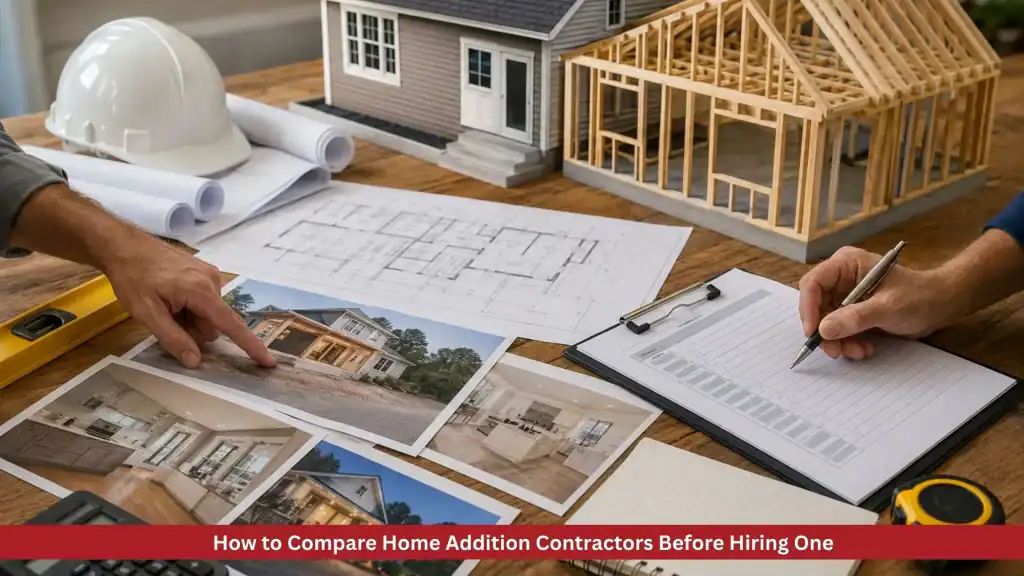
| To compare home addition contractors effectively, verify Nevada contractor licensing, confirm documented experience with residential home additions specifically, review real project portfolios and references, compare written scope-of-work documents rather than just price totals, and confirm how each contractor handles permitting and subcontractor management. A home addition contractor who cannot answer clearly on any of these points is a contractor worth skipping regardless of their price. |
Hiring a home addition contractor is one of the higher-stakes decisions a Las Vegas homeowner makes. A residential home addition is not a small repair. It is a structural project that touches your foundation, your roofline, your electrical and plumbing systems, and in many cases your HOA and Clark County permits. The wrong contractor does not just produce a bad result. They produce a bad result you have to pay someone else to fix.
The problem is that every contractor sounds qualified in a first conversation. Websites look professional. Portfolios show the best work. Prices are presented in ways that make comparison difficult. Knowing what to actually evaluate, beyond the polished pitch, is how Las Vegas homeowners protect themselves before a single dollar changes hands.
This guide covers the specific criteria that separate qualified home addition contractors from ones who will create problems mid-project or after completion.
Why Is Choosing the Right Home Addition Contractor So Important?
Residential home additions involve more moving parts than most homeowners anticipate before they start getting quotes. A room addition requires structural engineering, foundation work, framing, roofing tie-in, electrical and plumbing extensions, HVAC modifications, drywall, flooring, and finish work, all coordinated in sequence and all subject to Clark County or City of Las Vegas inspections at multiple stages.
A contractor who manages that sequence well keeps the project on time, on budget, and compliant. A contractor who manages it poorly creates gaps between trades, fails inspections, or skips steps that surface as problems during a future home sale.
The cost of a failed home addition project is not just the repair bill. It is the disruption to your household during extended delays, the stress of dealing with unpermitted work discovered by a buyer’s inspector, and in serious cases, the structural risk of a poorly built addition that connects to the primary living space of your home.
Getting the contractor selection right from the start is the highest-leverage decision in the entire project. For context on what residential home additions actually involve, the full home remodel and home addition cover the process phase by phase.
How Do You Verify a Home Addition Contractor’s License in Nevada?
This is the first filter, and it is non-negotiable. Nevada requires contractors to hold a license issued by the Nevada State Contractors Board (NSCB) for any project exceeding $1,000 in combined labor and materials. A residential home addition almost always exceeds that threshold by a significant margin.
The NSCB license database is publicly searchable at nscb.nv.gov. Enter the contractor’s name or license number and confirm the following:
The license is active. An expired or suspended license means the contractor cannot legally perform the work. Do not accept a contractor’s word that a renewal is pending.
License classification covers the work. Nevada issues licenses by trade classification. A general contractor license (Class A or Class B) covers residential home additions. A specialty trade license covers specific scopes like electrical or plumbing but not full addition projects. Confirm the classification matches the scope you are hiring for.
Bond and insurance are current. The NSCB record shows whether the contractor’s bond is active. Ask separately for a certificate of general liability insurance and workers’ compensation coverage. Your homeowner’s insurance does not cover injuries to uninsured workers on your property.
The bid limit is sufficient. Nevada contractor licenses carry bid limits that cap the dollar value of projects a contractor can legally take on. For a larger residential home addition, confirm the contractor’s bid limit covers your project value.
What Experience Should a Residential Home Additions Contractor Have?
Licensing confirms legal standing. Experience determines execution quality. These are separate things, and both matter.
A general contractor who primarily does kitchen and bathroom remodels is not automatically qualified to manage a structural home addition. The scope difference is significant. Additions require foundation assessment and extension, roofline integration that prevents water intrusion, load calculations for new structural members, and coordination with multiple inspection stages that kitchen remodels do not involve.
When evaluating a home addition contractor’s experience, ask specifically:
How many residential home additions have you completed in the last two years? A contractor who lists one or two additions among dozens of smaller projects has limited addition-specific experience. Look for contractors where additions are a core part of their work, not an occasional project type.
What types of additions have you built? Room additions, second-story additions, ADUs, sunrooms, and garage conversions each have different structural and permitting demands. If your project is a second-story addition, a contractor whose addition experience is limited to single-story room add-ons is not the right fit.
Can you provide references from home addition projects specifically? General remodeling references are not the same as addition references. Ask for contact information for two or three past addition clients and actually call them.
Do you have a structural engineer relationship? Residential home additions require engineering documents as part of the permit package. A home addition contractor who does not have an established relationship with a licensed structural engineer is either planning to skip engineering or will outsource it to someone they have never worked with.
How Do You Compare Quotes from Home Addition Contractors Without Being Misled?
Price comparison is where most homeowners make mistakes. Three quotes for the same addition can vary by 40 percent or more, and the lowest number is not always the best value or even an honest representation of the full cost.
The only way to compare quotes accurately is to compare scopes, not totals. Here is what to look for.
Written scope of work. A legitimate home addition contractor provides a detailed written scope of work, not a one-line summary. It should itemize demolition, foundation work, framing, roofing, insulation, windows and exterior doors, electrical, plumbing, HVAC, drywall, flooring, paint, and trim. If any of those line items are missing or vague, ask why.
Permit and engineering fees included. Some contractors quote the build cost and list permits and engineering as add-ons. Others include them. Ask specifically whether permit fees, plan check fees, and structural engineering are included in the quoted number.
Allowances vs. specified materials. Quotes that use allowances for cabinets, fixtures, flooring, and tile leave the actual cost undefined. Allowances are frequently set below what the homeowner actually selects, creating change orders after the contract is signed. Wherever possible, specify materials before signing and get them priced into the contract.
Payment schedule. A standard payment schedule for residential home additions ties payments to project milestones: deposit at contract, payment at foundation completion, payment at framing, and so on. A contractor requesting 50 percent or more upfront before work begins is a red flag.
Change order process. Ask how the contractor handles changes to scope mid-project. A clear written change order process with pricing before the change is authorized protects both parties. A contractor who is vague about this is one who will surprise you with invoices later.

What Should You Check in a Home Addition Contractor’s Portfolio?
A portfolio of past work tells you whether a contractor’s quality matches their pitch. Most contractors show their best projects. Your job is to look deeper than the hero photos.
Look for structural variety. A portfolio that shows only finished interior photos tells you about finishes. A portfolio that includes framing photos, foundation work, and roofline integration shows structural competence. Both matter for a residential home addition.
Check for projects similar to yours. If you are adding a second story, look for second-story additions in the portfolio. If you are building a detached ADU, find ADU projects. Style and scale similarity between past work and your project is a meaningful indicator of fit.
Look at the integration points. The hardest part of any home addition is where the new structure meets the existing one. Roofline transitions, exterior finish matching, and interior flow from old to new space are where less experienced contractors show their limitations. If portfolio photos include clear shots of these transition zones, it is a positive sign.
Ask to visit a completed project. A contractor confident in their work will offer this. Seeing a finished addition in person, especially one similar to yours, is more informative than any portfolio page.
For examples of the addition types LV Home Service handles, including ADUs, casitas, room additions.
How Should a Home Addition Contractor Handle Permitting?
Permitting is where underprepared contractors lose projects. Clark County and the City of Las Vegas have specific requirements for residential home additions, including architectural drawings, structural engineering documents, energy compliance calculations, and site plans. The permit review process takes time, and errors in the submittal package extend that time.
A qualified home addition contractor manages permitting as part of the project from day one. They know what each jurisdiction requires, they submit complete packages, and they respond to correction notices promptly rather than letting them sit.
Ask each contractor you are evaluating:
Who handles permit submission? The contractor or a permit expediter they work with? Either can work well. What matters is that there is a specific person responsible for this and a clear process for tracking status.
How long do you estimate permitting will take for this project? An experienced home addition contractor gives a realistic answer based on current Clark County or City of Las Vegas processing times. An inexperienced one gives you a number that is too optimistic.
What happens if the permit submittal comes back with corrections? Corrections are common. The question is how quickly the contractor responds and resubmits. Ask for a past example.
Will all work be permitted? This should not need to be asked, but ask it anyway. Some contractors propose doing portions of the work without permits to save time or cost. Unpermitted work in a residential home addition creates serious problems at resale and with insurance claims. If a contractor suggests skipping permits on any portion of structural, electrical, or plumbing work, end the conversation.
Understanding what the permitting process involves before you start helps set realistic expectations. The ADU vs. room addition covers Las Vegas-specific permitting requirements for both project types in detail.
Final Thoughts
Comparing home addition contractors takes more time upfront than most homeowners want to spend. The comparison process, verifying licenses, reviewing scopes line by line, calling references, and checking portfolios in detail feels slow when you are eager to start building.
That time investment pays back many times over. A residential home addition built by the right contractor runs on schedule, passes inspections cleanly, integrates well with the existing home, and adds real value to the property. The same project with the wrong contractor produces delays, disputes, and a finished product that reveals its shortcuts over time.
Spend the time on the front end. It is the most valuable work you do on the entire project.
Frequently Asked Questions
Q: How many quotes should I get before hiring a home addition contractor?
A: Three is the standard recommendation, and it is a good one. Three quotes give you enough range to identify outliers on both the high and low end and enough detail to compare scopes meaningfully. Getting more than four or five quotes is often counterproductive because the comparison becomes unwieldy. Focus on getting three detailed, written quotes from licensed contractors with documented residential home addition experience.
Q: What is a reasonable deposit for a residential home addition project?
A: A deposit of 10 to 15 percent of the total project value is standard for residential home additions in Las Vegas. Some contractors request up to 20 percent for projects with significant material pre-orders, which is reasonable if the payment is tied to confirmed material orders. Requests for 30 percent or more upfront before work begins are outside the norm and worth questioning.
Q: Should a home addition contractor provide a written contract?
A: Yes, always. A written contract is legally required in Nevada for projects over $1,000 and is non-negotiable for a residential home addition regardless of how well you know the contractor. The contract should include the full scope of work, materials specified, payment schedule tied to milestones, timeline with start and projected completion dates, and the change order process. Never begin work based on a verbal agreement or a one-page quote.
Q: How long does a typical residential home addition take in Las Vegas?
A: Timeline depends on the type and size of the addition. A single-room addition typically takes three to five months from permit approval through final inspection. A second-story addition or ADU runs six to twelve months. Permitting itself takes two to four months in most Clark County and City of Las Vegas jurisdictions. A home addition contractor should provide a phase-by-phase timeline as part of the proposal.