
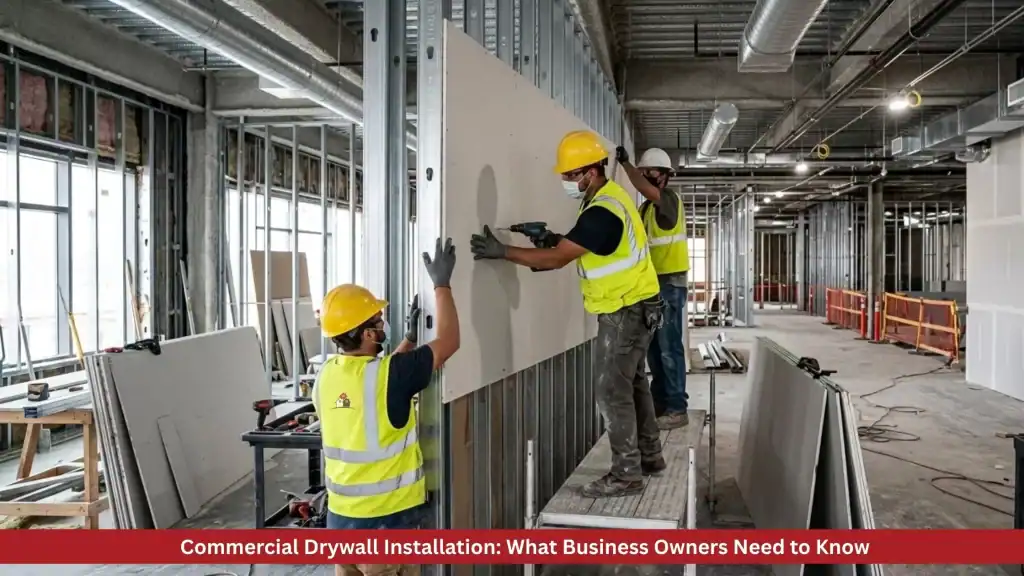
| Commercial drywall installation in Las Vegas differs from residential work in the materials used, fire and sound rating requirements, metal stud framing, ceiling system complexity, and permitting scope. Business owners should expect a licensed drywall installation service to handle material selection, code compliance, and coordination with electrical and mechanical trades. Project timelines and costs depend on square footage, wall height, finish level, and whether fire-rated assemblies are required by code for your occupancy type. |
Most business owners think about drywall exactly once: when something goes wrong. A hole appears, water damage ruins a wall, or a remodel exposes framing that needs to be closed back up. But commercial drywall installation is a more involved discipline than its residential counterpart, and treating it like a simple patch job or a weekend project creates problems that show up during inspections, in utility bills, and in the long-term durability of the finished space.
If you are opening a new location in Las Vegas, reconfiguring an office layout, building out a retail or restaurant space, or repairing damage after a water or fire event, understanding what commercial drywall services actually involve helps you plan better, budget more accurately, and avoid the contractor mistakes that derail commercial build-outs.
What Makes Commercial Drywall Installation Different from Residential Work?
The differences start at the framing. Residential drywall goes up over wood studs. Commercial drywall installation almost always involves metal stud framing, which is lighter, more dimensionally stable, and better suited to the larger spans and ceiling heights common in commercial spaces.
Metal stud systems are also faster to install in large open floor plans and easier to reconfigure when tenants change or layouts shift. For Las Vegas business owners in leased commercial space, metal stud framing is standard, and any drywall services contractor working in that environment needs to be fluent with it.
Beyond framing, commercial work involves wall and ceiling assemblies that are rated for fire resistance and sound attenuation. Residential construction has fire and sound requirements, but they are less demanding than what commercial occupancy classifications require. A restaurant, medical office, multi-tenant retail center, or professional office suite all carry specific rated assembly requirements that govern which drywall products, stud gauges, fastener patterns, and insulation types are used in each wall location.
Getting those ratings wrong does not just mean a failed inspection. It means tearing out completed work and starting over, which is an expensive lesson that businesses in Las Vegas have learned the hard way when they hired a contractor without commercial experience for a commercial project.

What Types of Drywall Are Used in Commercial Drywall Installations?
Standard half-inch drywall is what most people picture. Commercial drywall installation uses several product types depending on the location and performance requirement of each wall or ceiling assembly.
Type X fire-rated drywall is the most common specialty product in commercial construction. It contains glass fibers that slow the spread of fire through a wall assembly. Most commercial occupancies require Type X drywall in specific locations, including stairwells, corridor walls, mechanical rooms, and party walls between tenant spaces. The thickness is typically five-eighths of an inch.
Moisture-resistant drywall (often called green board or purple board depending on the manufacturer) is used in restrooms, kitchens, break rooms, and any area with regular humidity exposure. In Las Vegas, where commercial kitchens and restaurant restrooms see heavy daily use, specifying the correct moisture-resistant product and pairing it with proper tile installation extends the life of those assemblies significantly.
Abuse-resistant drywall is a thicker, harder-core product used in high-traffic areas like corridors, lobbies, and retail spaces where walls take regular impact from carts, equipment, or heavy foot traffic. It dents and punctures less easily than standard drywall and reduces the frequency of repair calls.
Soundproof drywall (mass-loaded vinyl core or layered high-density products) is used in conference rooms, medical treatment rooms, legal offices, and any space where acoustic privacy is a functional requirement. In Las Vegas, hospitality and medical tenants specify acoustic assemblies as a baseline.
Exterior sheathing. Some commercial builds use gypsum-based exterior sheathing products behind stucco, EIFS, or other cladding systems. This material is distinct from interior drywall but falls under the same trade scope for many drywall services contractors.
What Code Requirements Apply to Commercial Drywall Installation in Las Vegas?
Nevada follows the International Building Code (IBC), adopted by Clark County and the City of Las Vegas with local amendments. Your occupancy classification determines which fire-resistance ratings apply to walls and corridors, with most commercial spaces requiring one-hour or two-hour rated assemblies in exit paths and tenant separation walls.
ADA clear-width requirements affect framing placement, Nevada’s energy code governs insulation in exterior and unconditioned-space walls, and building permits with phased inspections are required for all commercial drywall work. A licensed drywall installation service in Las Vegas manages code compliance and inspection scheduling as part of the project.
How Is Commercial Drywall Installation Scheduled Around a Business?
This is the question Las Vegas business owners care about most, because downtime costs money. A retail location that closes for two weeks loses sales. A restaurant that cannot open on schedule loses reservation revenue and soft-opening momentum.
Commercial drywall services contractors in Las Vegas plan project sequencing around business operations in three main ways.
Phased installation. For occupied buildings where only a portion of the space is being reconfigured, work proceeds section by section. One zone is demoed, framed, and drywalled while the rest of the business continues operating. Dust containment barriers between active and inactive zones keep the workspace usable.
After-hours and weekend scheduling. For businesses that operate during standard daytime hours, framing and drywall crews work evenings and weekends. This approach is common for office suites, medical offices, and retail build-outs in occupied commercial centers.
Fast-track sequencing. When a business needs to open by a fixed date, the project is sequenced to keep trades moving without gaps. Electricians and plumbers are roughing in while framing is being completed in adjacent areas. Drywall installation follows immediately after rough-in inspections pass rather than waiting for all framing to be complete.
LV Home Service handles commercial drywall installation in Las Vegas with scheduling built around business timelines.
What Does Commercial Drywall Installation Cost in Las Vegas?
Cost per square foot for commercial drywall installation in Las Vegas ranges from $3.50 to $8.00 for standard assemblies and higher for fire-rated, acoustic, or abuse-resistant work. Several factors drive where a project lands in that range.
Ceiling height. Standard eight to nine-foot residential ceilings are one thing. Commercial spaces with twelve, fourteen, or eighteen-foot ceilings require scaffolding or lifts, more material, and more installation time per square foot.
Assembly complexity. A simple office partition wall costs less per foot than a two-hour fire-rated corridor assembly. Acoustic walls with specialty drywall and decoupled framing cost more than standard metal stud partitions.
Finish level. Commercial drywall finishing is graded on a scale from Level 0 (unfinished) to Level 5 (skim-coated, highest quality). Paint-ready walls in a professional office or hospitality space require a Level 4 or Level 5 finish. Utility spaces and storage rooms may stop at Level 3. The finish level significantly affects labor cost.
Remediation scope. If commercial drywall installation follows water damage or fire damage, the demolition and remediation work adds to the total cost before new material goes up. For Las Vegas businesses dealing with water damage that reached the drywall, home restoration and rebuild services handle both the remediation and drywall reinstallation as a coordinated scope.
What Are the Signs That Your Commercial Space Needs New Drywall Services?
Beyond scheduled build-outs, commercial spaces in Las Vegas often need drywall services for condition-driven reasons. Knowing the signs keeps small problems from becoming large ones.
Visible cracks at joints or corners. Hairline cracks at taped joints are common in new construction as the building settles. Wide cracks, recurring cracks in the same location, or cracks accompanied by door misalignment indicate structural movement that needs investigation before drywall repair.
Soft or discolored wall sections. Moisture intrusion from roof leaks, HVAC condensate issues, or plumbing drips creates soft spots in drywall that do not recover when they dry. Discoloration, bubbling paint, or a persistent musty smell in a section of wall are signs that the drywall has been compromised and needs to come out.
Impact damage in high-traffic areas. Cart impacts in stockrooms, equipment contact in kitchens, and general traffic in corridors damage drywall consistently in active commercial spaces. Patching individual holes eventually becomes less economical than replacing damaged sections with abuse-resistant product that holds up better going forward.
Popcorn or dated ceiling texture. Many older Las Vegas commercial spaces still have original popcorn ceilings from the 1980s and 1990s. Removing and replacing with a smooth or contemporary texture is part of a commercial refresh that improves the look of the space without full build-out costs. LV Home Service handles custom texture and popcorn ceiling removal as part of their commercial drywall services scope.
For business owners who are uncertain whether drywall needs repair or full replacement, the 7 signs it is time to replace your drywall covers the decision criteria in detail.
Why Does Choosing the Right Drywall Installation Service in Las Vegas Matter for Commercial Projects?
Commercial drywall installation is not a commodity trade in the way some business owners assume. The quality of the finish, the accuracy of fire-rated assembly installation, and the contractor’s ability to sequence work around business operations all vary significantly between providers.
A contractor who primarily does residential patch work is not automatically qualified for a commercial build-out with rated assemblies, metal stud framing, and phased scheduling in an occupied building. The code knowledge, product familiarity, and project management requirements are different.
What to confirm before hiring a drywall installation service in Las Vegas for commercial work:
- Nevada contractor license in the appropriate classification (C-4 or C-5 framing and drywall, or a general contractor license covering these scopes)
- Documented commercial project experience, not just residential
- Familiarity with IBC fire-resistance assembly requirements
- Ability to coordinate with other trades and manage inspection scheduling
- References from commercial clients, not only homeowners
Final Thoughts
Commercial drywall installation in Las Vegas is one of those scopes that looks straightforward until something goes wrong. A failed inspection on a fire-rated assembly, a moisture problem that was drywalled over, or a finish level that does not hold paint correctly are all fixable problems, but they are also expensive and disruptive to fix after the fact.
The right approach starts before framing goes up: the right products for the occupancy type, the right contractor for commercial work, and a schedule that accounts for inspections, trade coordination, and your business operations. Get those three things right, and the drywall becomes the least complicated part of your project.
Frequently Asked Questions
Q: What type of drywall is required for commercial buildings in Las Vegas?
A: It depends on the occupancy classification and wall location. Most commercial occupancies require Type X fire-rated drywall in corridors, exit paths, and walls separating tenant spaces. Restrooms and kitchens require moisture-resistant products. High-traffic corridors and retail spaces benefit from abuse-resistant drywall. A licensed drywall installation service in Las Vegas will specify the correct products for each assembly location based on IBC requirements and Clark County amendments.
Q: How long does commercial drywall installation take?
A: The timeline depends on square footage, ceiling height, assembly complexity, and whether the project is phased around an operating business. A straightforward single-suite office build-out of 2,000 to 3,000 square feet typically takes one to two weeks for framing and drywall. Larger or more complex projects with rated assemblies, specialty finishes, and multi-phase scheduling take longer. A drywall services contractor will give you a phase-by-phase timeline during the estimating process.
Q: Can commercial drywall installation happen while my business stays open?
A: Yes, with proper planning. Phased installation, dust containment barriers, and after-hours or weekend scheduling all allow commercial drywall work to proceed in occupied spaces. The key is to coordinate the sequence with your operations so that active work areas remain separate from customer and employee areas throughout the project.
Q: Do I need permits for commercial drywall installation in Las Vegas?
A: Yes, in most cases. Any commercial build-out involving new wall framing, fire-rated assemblies, or changes to the existing layout requires a building permit through Clark County or the City of Las Vegas. Inspections are required at rough framing, insulation, and drywall stages before work can proceed. A licensed drywall installation service handles permit submissions and inspection scheduling as part of the project.
Q: How do I know if my commercial drywall needs repair or full replacement?
A: Isolated holes, minor surface damage, and small cracks are repair situations. Full replacement makes more sense when moisture has compromised the core, when mold is present behind the surface, when damage covers a large section of wall, or when the existing finish level no longer meets your space’s appearance standards. A drywall services contractor can assess the condition and give you a clear recommendation before any work begins.